all
YOU
NEED
TO
KNOW
ABOUT
Badminton

If your whole badminton experience is a random backyard set or watching others play from the sidelines, this is your quick catch‑up.
Badminton is a racket sport played 1v1 (singles) or 2v2 (doubles), where players hit a lightweight shuttlecock over a net without letting it touch the ground. The rallies are fast, the court is small (split by a net at 1.55 m), boundaries shift slightly for singles vs doubles, and quick reactions matter more than raw strength.
Games are usually played to 21 points. Every rally counts, and you have to win by 2.
Why people get hooked
Badminton looks gentle from the sidelines. On court, it’s agility, sharp reflexes, and a lot more sweat than you’d expect. You don’t need a huge serve or a big jump to enjoy it. If you like fast rallies, light equipment, and the kind of game where you can laugh between points, you’ll probably like badminton.
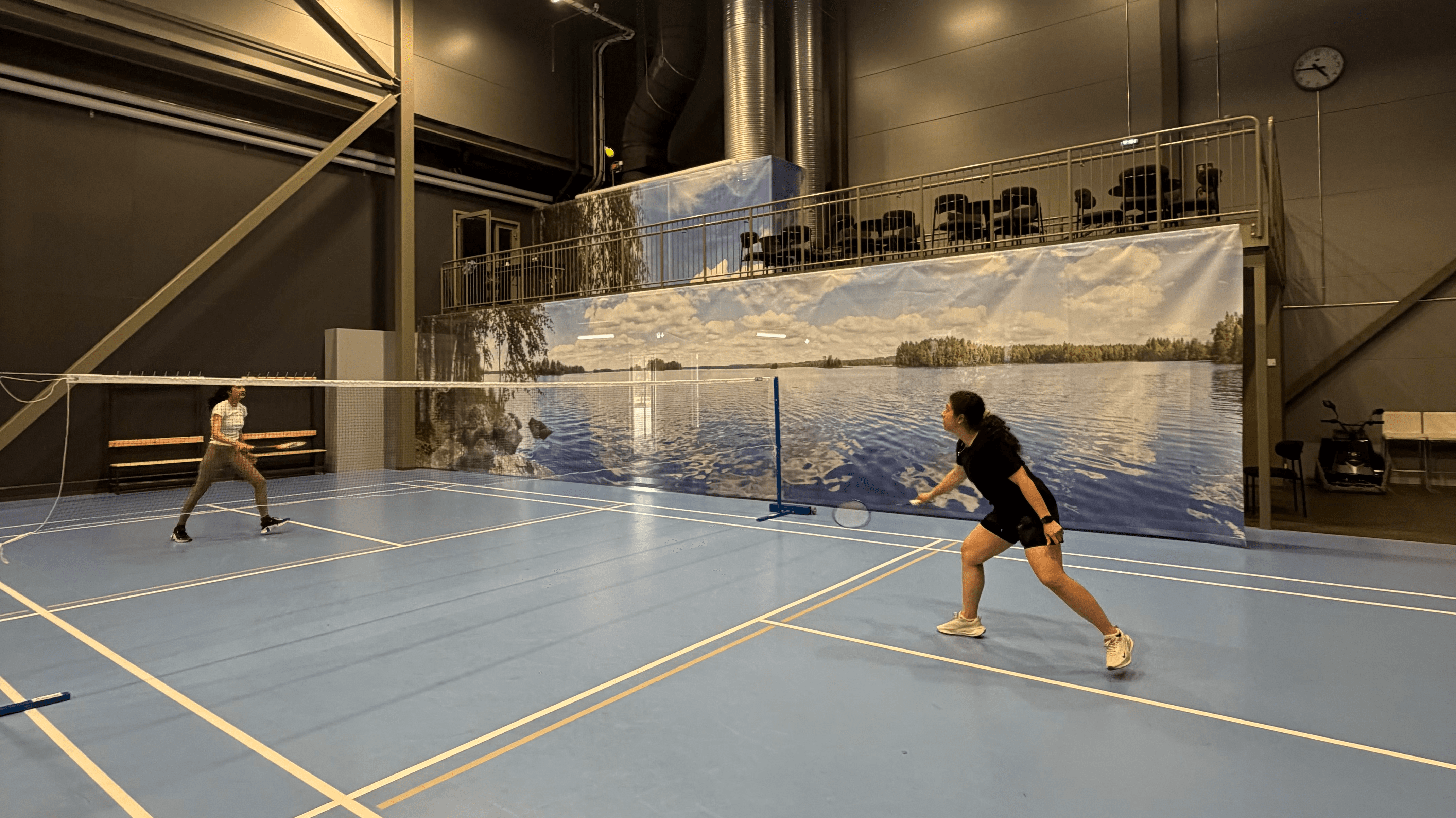
What to bring
Shoes: Court shoes are great if you have them, but standard trainers work just fine. Just skip the flip-flops or fuzzy slippers.
Clothes: Breathable clothing beats fashionable. Avoid jeans; they restrict movement and will make you sweat more than necessary.
Water bottle: Stay hydrated! You’ll be moving more than you think.
Racket: Bring your own if you have a favourite. If not, house rackets are usually available.
Towel: Keep one handy. “Post‑game you” will thank the “pre‑game you”.
Rules of the game
How to serve
Hit the shuttle below your waist. No exceptions.
The serve must travel diagonally and land inside the opposite service box.
Both feet must stay on the ground until you’ve struck the shuttle; no lunging or jumping into the serve.
You get one attempt. If you swing and miss the shuttle completely, it still counts as a serve.
Singles vs. doubles court
This is the one that trips up most beginners:
Singles: The court is long and narrow, utilising the full length of the playing area, but the side alleys are always out of bounds.
Doubles: The court is short and wide, meaning you lose the back service strip, but you gain the side alleys.
Switching formats can be tricky, and you’ll probably serve out of bounds at least once. It happens to almost everyone early on.
Who serves next
In singles, your score decides your side: even score, serve from the right; odd score, serve from the left.
In doubles, service rotates between partners as your team wins points. The server swaps sides each time their team scores. This is the most common point of confusion in casual play, so don’t worry if you need to pause and check.
Every rally counts
Whoever wins the rally gets the point, regardless of who served.
Winning a game
The first to 21 points wins the game.
You must win by at least 2 points.
If you are tied at 20–20, play continues until someone leads by 2.
At 29–29, the next point wins outright. 30 is the cap.
Matches are typically best composed of 3 games.
In or out?
The lines are part of the court. If the shuttle touches the line, it’s in.
Common faults
The shuttle lands outside the lines.
The shuttle hits the ceiling or any obstruction before landing.
Your racket, body, or clothing touches the net during play.
You hit the shuttle before it crosses to your side of the net.
You carry or double‑hit the shuttle instead of one clean hit.
When a point gets replayed
If something unexpected interrupts the flow of the game, you call a 'Let.' This is just a formal way of saying 'do-over' – the point doesn't count, and you simply replay it.
The shuttle gets stuck on top of the net after crossing over.
A serve happens before the receiver is ready.
Play is interrupted by something outside anyone’s control.
These are rare in casual games, but useful to know so a point doesn’t turn into a full argument.
A few unwritten rules
Badminton, like most casual games, doesn’t have an umpire, so a few norms help things run smoothly:
Call your own lines, honestly. If you’re unsure, give it to your opponent – play it as “in.”
In doubles, communicate with your partner. A quick “mine” or “yours” avoids most confusion.
Keep it friendly. Avoid smashing at full power if you’re playing against someone who’s clearly a beginner and standing near the net.
Win or lose, say “Good game.” Small thing, but it sets a positive tone for the whole group.
Ready to play?
Badminton is easy to pick up, but it’s best when you’re playing with the right crowd. You don’t need to be a pro; you only need a partner who’s there to have fun.
On Courtship, you can skip the guesswork. Find local games tailored to your skill level, coordinate with people who match your pace, and join a community that cares about the rally, not just the score.
join the
next
game of
badminton
Participate in an open game or host a game and invite people to join you.

© 2026 Courtship. All rights reserved.